

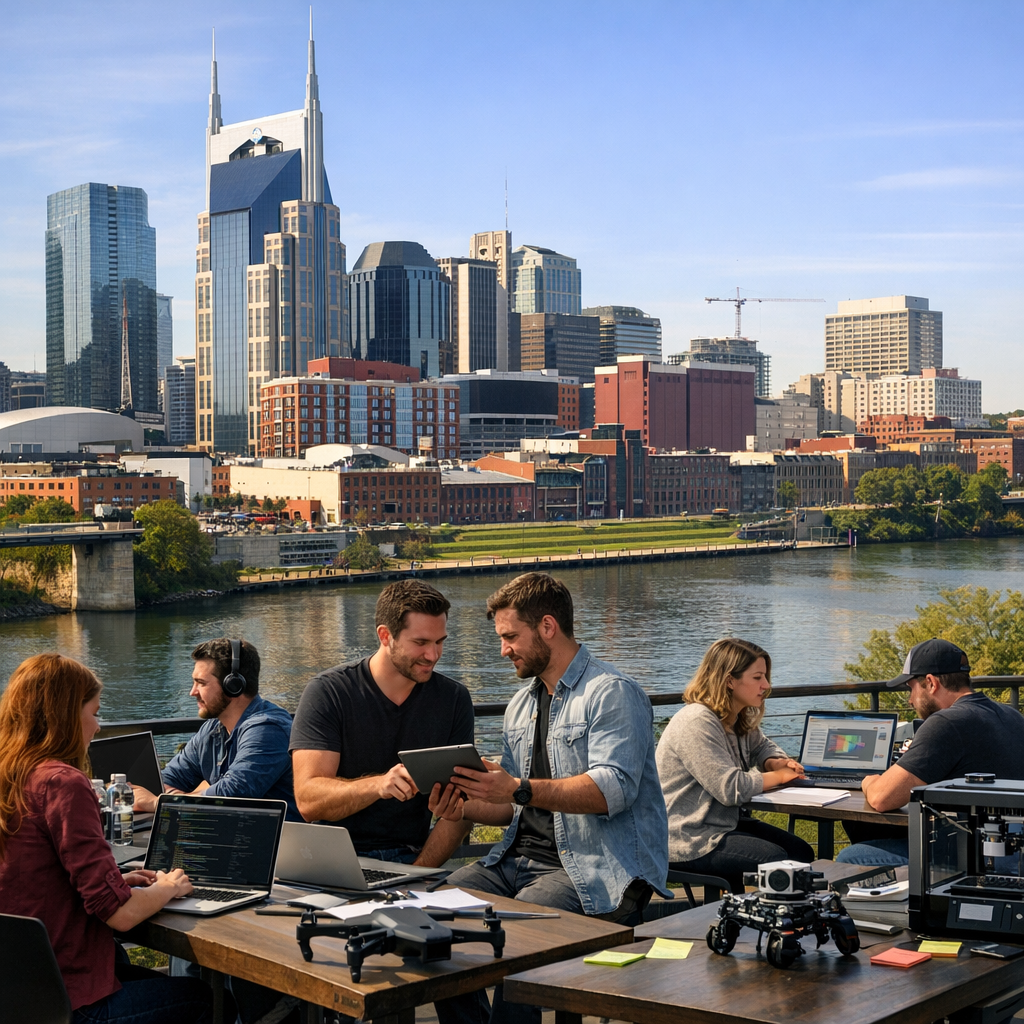
Nashville is rapidly emerging as a hub for artificial intelligence (AI), with local startups and established companies driving innovation across various sectors. However, this growth brings both opportunities and challenges for the community.
Local AI Startups Making an Impact
Several Nashville-based companies are at the forefront of AI development:
- Music City AI: This company tailors AI solutions for essential local businesses, including HVAC, plumbing, dental, and auto repair services. Their offerings range from 24/7 emergency call handling to appointment scheduling, enhancing operational efficiency for small businesses.
- Raystone Automations: Specializing in AI automation for service industries, Raystone provides voice agents, workflow integrations, and marketing solutions. Their AI voice agents reportedly answer 97% of inbound calls on day one, operating around the clock and reducing operating costs by an average of 40% compared to full-time hires.
- ViNIL: Founded by Nashville songwriter Charles Alexander, attorney Jeremy Brook, and software architect Sada Garba, ViNIL addresses the growing issue of deepfake content. The platform enables musicians and celebrities to certify AI-generated media created with their consent, helping differentiate authentic content from unauthorized deepfakes.
AI Integration in Education
Alpha Schools, a private education institution integrating AI into its learning model, plans to expand from a dozen to 50 campuses during the 2026 school year. Unlike traditional schools still struggling with AI adoption, Alpha has designed a model that limits students to two hours of daily screen time for core subjects using AI, dedicating the rest of the day to life skills and experiential learning, such as organizing community events. Founder Price argues that traditional schools mishandle AI, either overusing or banning it. With broader implementation lagging in public education, Alpha’s expansion reflects growing interest in innovative learning approaches. However, some educators caution that AI-based models may conflate teaching with tutoring.
Controversies Surrounding AI Developments
Despite the positive strides, some AI initiatives have sparked controversy:
- Data Center Near Nashville Zoo: The Nashville Zoo is leading opposition against the construction of a 69,000-square-foot data center planned adjacent to its grounds. Concerns include potential threats to animal welfare, noise and light pollution, and water quality. A petition against the project has garnered over 375,000 signatures. The zoo emphasized the risks to its clouded leopard breeding program and the possible cancellation of a planned Okapi breeding facility. In response, the Metro Planning Commission is considering new legislation that proposes strict zoning rules for data centers in Davidson County.
- Waymo’s Self-Driving Robotaxis: Waymo plans to launch its self-driving robotaxi service in Nashville in 2026 through a partnership with Lyft. While this collaboration aims to enhance transportation options, it has faced criticism in other cities for issues such as stalling, speeding, and erratic behavior. The success of this initiative in Nashville remains to be seen.
Conclusion
Nashville’s AI landscape is a dynamic mix of innovation and debate. As local companies continue to develop and implement AI technologies, the community must navigate the benefits and challenges these advancements bring. Ongoing dialogue and thoughtful regulation will be essential to ensure that AI serves the best interests of all Nashvillians.