

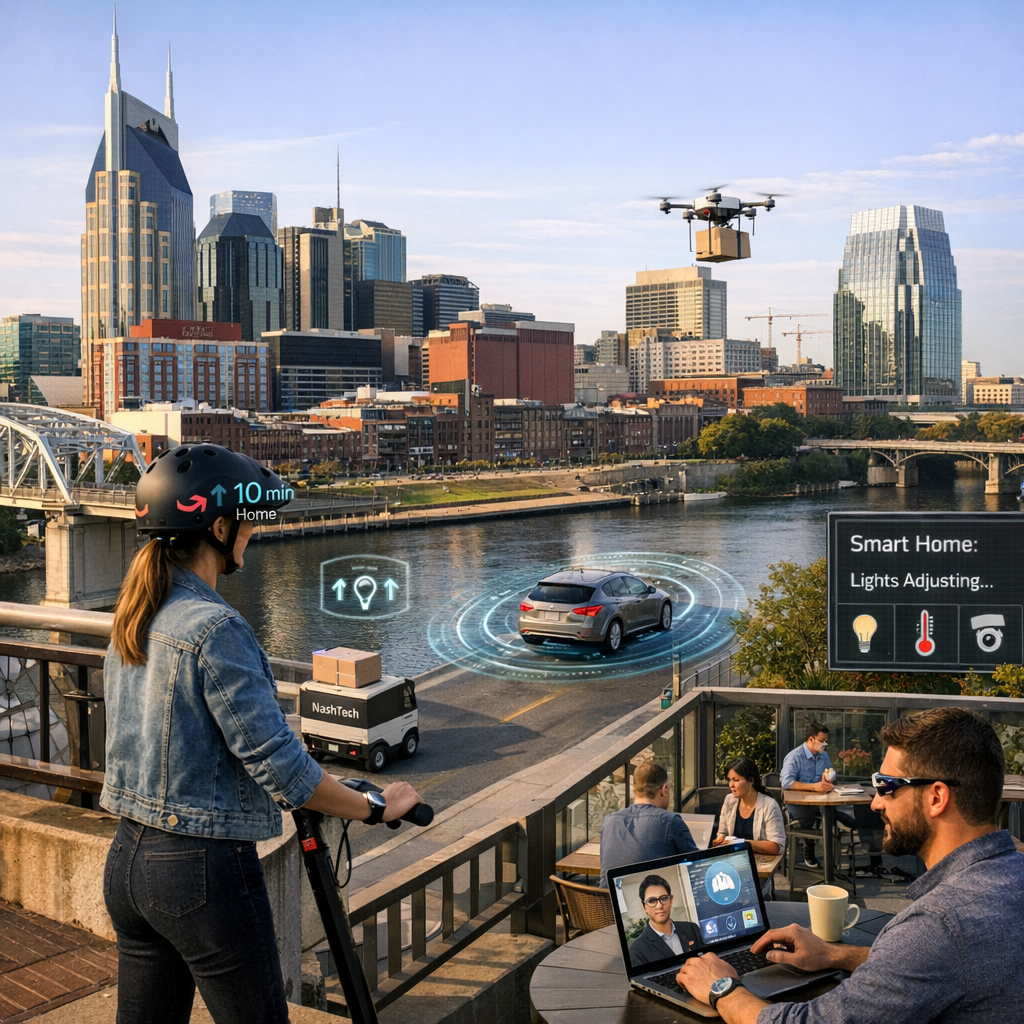
Artificial Intelligence (AI) is rapidly becoming a cornerstone of innovation in Nashville, influencing sectors from healthcare to entertainment and reshaping daily life for its residents.
AI Startups Leading the Charge
Nashville’s startup ecosystem is vibrant, with companies like UnityAI at the forefront. UnityAI’s ‘Agentic Workforce’ handles over 300,000 patient interactions monthly, showcasing the city’s commitment to integrating AI into healthcare services. Similarly, Metropolis Technologies applies computer vision to manage North America’s largest parking network, serving 50 million customers and enhancing urban mobility.
AI in Education
Educational institutions are also embracing AI. Alpha Schools, a private education institution that integrates artificial intelligence (AI) into its learning model, plans to expand from a dozen to 50 campuses during the 2026 school year. Unlike traditional schools still struggling with AI adoption, Alpha has designed a model that limits students to two hours of daily screen time for core subjects using AI, dedicating the rest of the day to life skills and experiential learning, such as organizing community events. Founder Price argues that traditional schools mishandle AI, either overusing or banning it. With broader implementation lagging in public education, Alpha’s expansion reflects growing interest in innovative learning approaches. However, some educators, like LeTendre, caution that AI-based models may conflate teaching with tutoring. Alpha’s upcoming expansion includes markets like Atlanta, Boston, Chicago, and Denver.
Addressing Deepfake Challenges
In the entertainment sector, ViNIL, a Nashville-based tech startup, is set to launch at the upcoming SXSW festival with a platform designed to tackle the growing issue of deepfake content. The startup enables musicians and celebrities to certify AI-generated media created with their consent, helping differentiate authentic content from unauthorized deepfakes. Instances of misused deepfakes include examples such as President Biden singing “Baby Shark” or Tom Hanks promoting a dental plan—none of which were authorized.
Community and Environmental Considerations
The integration of AI infrastructure has sparked community discussions. A proposed data center near the Nashville Zoo has faced opposition due to concerns about noise and light affecting sensitive species. Over 331,000 people have signed a petition against the project, and country star Brad Paisley labeled it a “nightmare scenario.” The Nashville Zoo has escalated its opposition by filing a zoning appeal to overturn the project’s permits, arguing it violates community and ecological interests. In response, the Metro Planning Commission will hold a public hearing on new legislation—Bill BL2026-1391—that proposes strict zoning rules for data centers in Davidson County. The bill, introduced by Councilmember Rollin Horton, would ban centers over 500,000 square feet and impose stringent buffer zones and cooling system requirements on smaller ones. While the DC BLOX facility falls below that size threshold, its proximity to the zoo could block it under the new rules.
Preparing for the AI Boom
Despite these challenges, Nashville is positioning itself for an anticipated boom in artificial intelligence (AI), with major players like Oracle and Amazon expanding their presence. Despite this, the city remains behind top contenders like New York in AI-related job growth—New York posted nearly 2,000 AI job listings this year alone. The data stems from a partnership among the University of Maryland, LinkUp, and the Outrigger Group. Nashville’s colleges are proactively adapting their programs to prepare students for the expected rise in AI employment, reflecting both concern and optimism over AI’s impact on the labor market. Lipscomb University President Candice McQueen views the AI surge as both a disruption and a transformative opportunity for the workforce. While some fear AI will replace jobs, the shift is also fostering new roles oriented around the technology. Meanwhile, Oracle’s expansion in Nashville continues, with its corporate offices projected to open by 2030.
As AI continues to evolve, Nashville stands at the intersection of innovation and tradition, embracing technological advancements while navigating the complexities they bring to the community.