

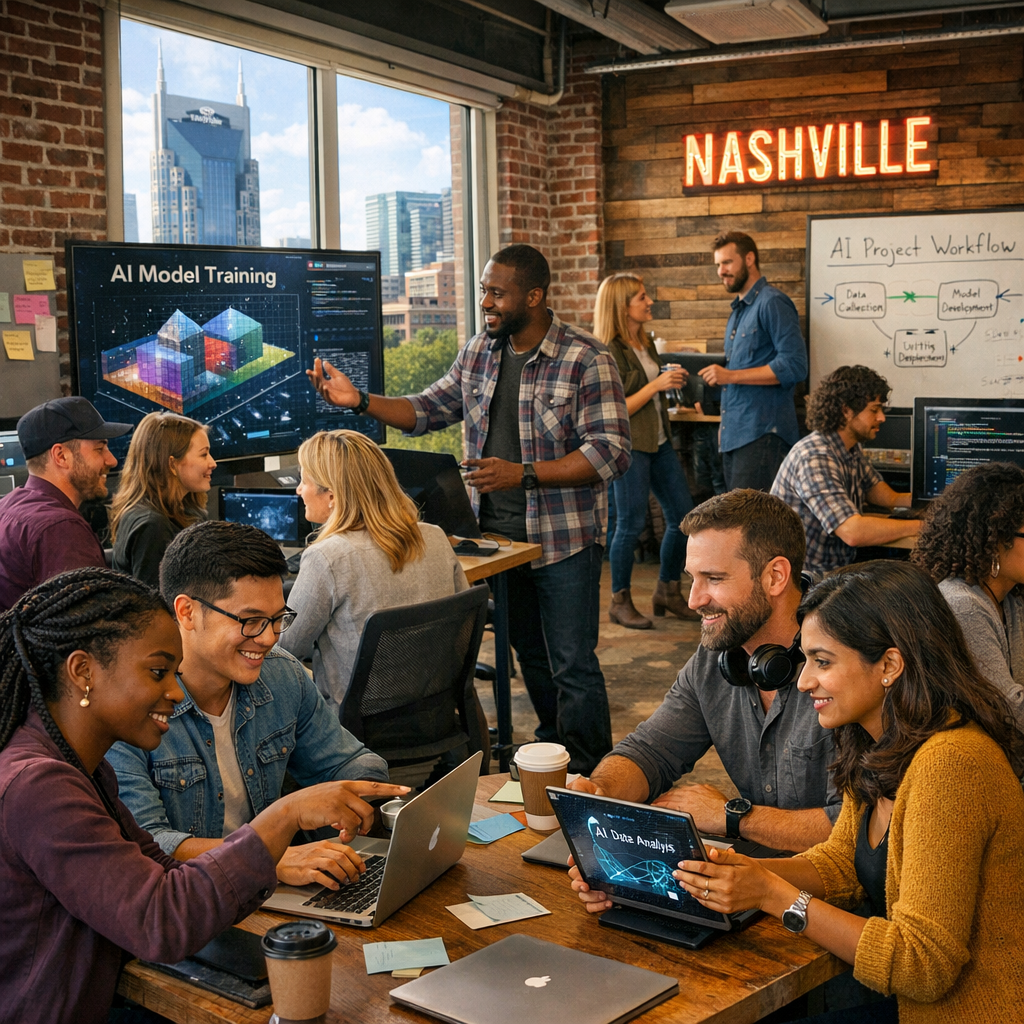
Nashville is rapidly emerging as a center for artificial intelligence (AI) innovation, with startups and tech companies transforming industries from healthcare to entertainment.
Healthcare Innovation
Companies like Main Street Health are revolutionizing patient care by integrating AI into their services. Main Street Health, based in Nashville, has been ranked the fastest-growing private company in the United States by Inc. Magazine. Founded in 2021, the company has experienced a remarkable 543% growth over the past three years. Main Street Health’s innovative business model involves partnering with small-town health clinics to deliver personalized care through “health navigators” targeted at senior patients. This approach aims to improve health outcomes in rural areas, addressing a significant need within the American healthcare system. The company’s rapid rise highlights Nashville’s growing reputation as a center for healthcare innovation and entrepreneurship.
AI in Education
Education is also experiencing an AI-driven transformation. Alpha Schools, a private education institution that integrates artificial intelligence (AI) into its learning model, plans to expand from a dozen to 50 campuses during the 2026 school year. Unlike traditional schools still struggling with AI adoption, Alpha has designed a model that limits students to two hours of daily screen time for core subjects using AI, dedicating the rest of the day to life skills and experiential learning, such as organizing community events. Founder Price argues that traditional schools mishandle AI, either overusing or banning it. With broader implementation lagging in public education, Alpha’s expansion reflects growing interest in innovative learning approaches. However, some educators, like LeTendre, caution that AI-based models may conflate teaching with tutoring. Alpha’s upcoming expansion includes markets like Atlanta, Boston, Chicago, and Denver.
Entertainment and Media
The entertainment industry is not left behind. ViNIL, a Nashville-based tech startup, is set to launch at the upcoming SXSW festival with a platform designed to tackle the growing issue of deepfake content. The startup enables musicians and celebrities to certify AI-generated media created with their consent, helping differentiate authentic content from unauthorized deepfakes. Instances of misused deepfakes include examples such as President Biden singing “Baby Shark” or Tom Hanks promoting a dental plan—none of which were authorized.
Founded by Nashville songwriter Charles Alexander, attorney Jeremy Brook, and software architect Sada Garba, ViNIL stands for Voice, Identity, Name, Image, and Likeness. Though still under development, the platform is aimed at artists, record labels, branding agencies, and others across the entertainment industry, with potential applications beyond music. The official unveiling will take place on March 12 at SXSW. The company clarified that ViNIL has been in development for close to a year.
Community and Infrastructure
However, the rapid growth of AI and tech infrastructure has raised community concerns. The Nashville Zoo is leading an opposition against the construction of a 69,000-square-foot data center planned adjacent to its grounds. Concerned about potential threats to animal welfare, noise and light pollution, and water quality, the zoo launched a petition that garnered over 375,000 signatures within a week. The zoo emphasized the risks to its clouded leopard breeding program and the possible cancellation of a planned Okapi breeding facility. Nashville Councilmember Courtney Johnston supports the zoo, filing a moratorium citing concerns over future expansion plans for a much larger facility.
Zoo CEO Rick Schwartz noted that the zoo had long wanted to buy the land for a conservation education center already partially constructed. The broader issue reflects a national movement questioning the environmental and health impacts of rapid data center expansion, with cities like Seattle imposing temporary bans. However, these moratoriums face legal challenges, as seen in Texas and North Carolina.
DC BLOX, the company behind the Nashville project, responded by asserting its commitment to community concerns, promising environmentally responsible practices such as waterless cooling, sound management, light shielding, and compliance with environmental laws. The company clarified the facility is intended to support regional internet infrastructure rather than function as an AI hub.
Looking Ahead
As Nashville continues to attract tech talent and investment, the city stands at the forefront of AI innovation. Balancing growth with community interests will be key to sustaining this momentum and ensuring that technological advancements benefit all residents.