

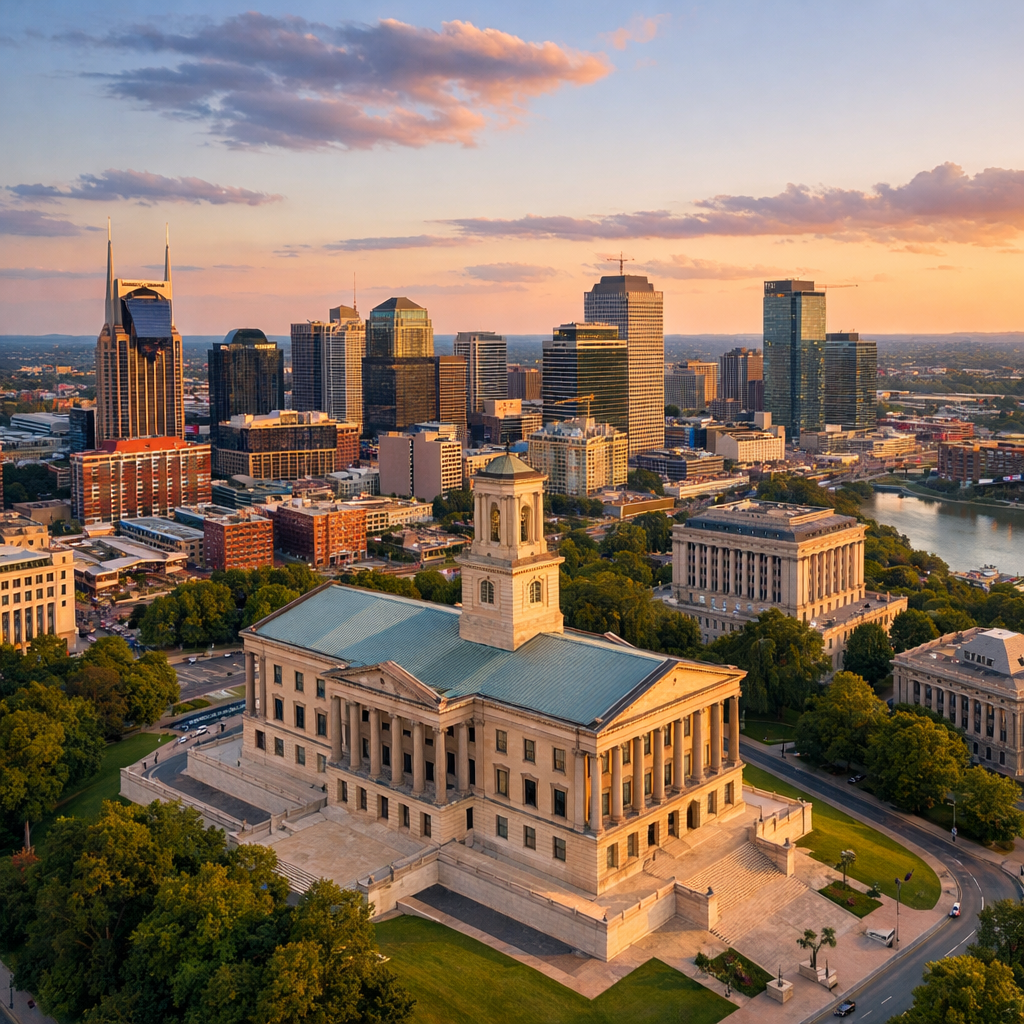
Nashville, Tennessee’s capital and largest city, stands out as a Democratic stronghold within a predominantly Republican state. This political divergence has led to a complex relationship between the city’s local governance and the state legislature.
Historical Context
Historically, Nashville has consistently supported Democratic candidates in presidential elections. For instance, in the 2020 election, approximately 75% of Davidson County voters favored the Democratic candidate, while the state overall leaned heavily Republican. This pattern underscores the city’s distinct political identity within Tennessee.
State Legislature Relations
The Republican-dominated Tennessee General Assembly has frequently enacted legislation that overrides local policies established by Nashville’s government. Notable instances include:
- Metro Council Reduction: In 2023, state lawmakers passed a law capping the size of metropolitan governing bodies at 20 members, a change that would force Nashville to cut its 40-seat council in half. Nashville sued, and a trial court sided with the city, ruling the law targeted Nashville unfairly. The state Court of Appeals reversed that decision, and the Tennessee Supreme Court heard oral arguments in February 2026. A ruling is expected sometime in 2026, and if Nashville loses, the council would shrink ahead of the 2027 elections.
- Community Oversight Board: The state legislature voted to abolish Nashville’s Community Oversight Board, a civilian-led police accountability body that Nashville voters had created by referendum in 2018 with roughly 59% approval. The legislature’s action dissolved the board entirely, reverting police misconduct investigations to internal affairs.
Redistricting and Representation
Following the 2020 census, the Tennessee General Assembly redrew Nashville’s congressional district, splitting Davidson County into three separate districts. This redistricting diluted the city’s voting power by ensuring Nashville Democrats were divided across three rural-majority districts.
Economic and Cultural Impact
Despite political tensions, Nashville continues to thrive economically and culturally. The city is a major hub for healthcare, music, and education, attracting a diverse population and fostering a vibrant cultural scene. Institutions like Vanderbilt University contribute significantly to the local economy, with the university and its medical center making a $22.13 billion annual economic impact on the city and state.
Conclusion
Nashville’s position as a Democratic enclave within a Republican state presents ongoing challenges and opportunities. The interplay between local and state politics requires continuous navigation to balance the city’s progressive policies with the state’s conservative stance.