

By Emily Johnson
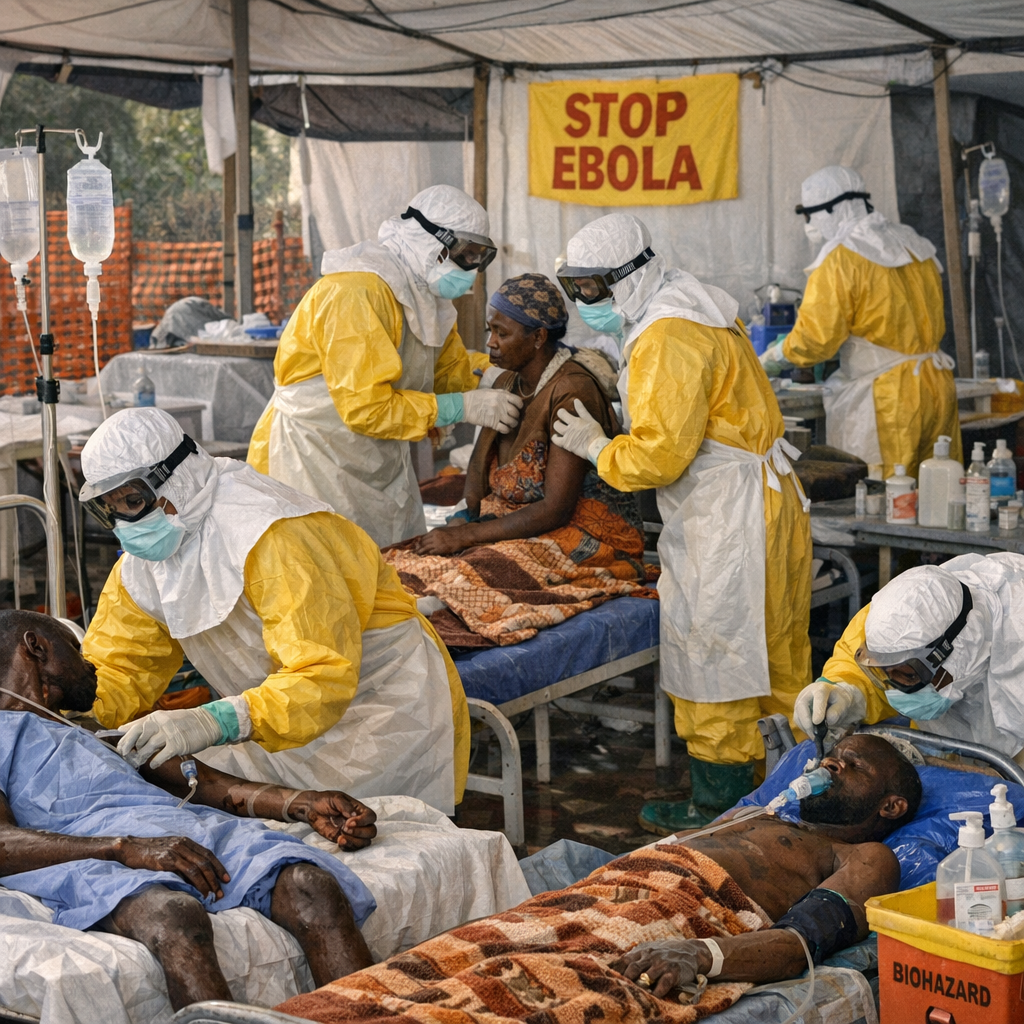
In recent months, the Democratic Republic of Congo (DR Congo) has been hit by the country’s fastest-spreading Ebola outbreak in history. A form caused by the Bundibugyo virus has spread rapidly across dozens of health zones, bringing with it mounting deaths, widespread displacement, and urgent questions—about preparedness, international coordination, and our ability to prevent this from becoming a far worse catastrophe.
What We Know
The outbreak began earlier this year in Ituri Province but has now expanded to 54 health zones across six provinces: Ituri, North Kivu, South Kivu, Haut-Uélé, Tshopo, and Bas-Uélé. As of mid-August, there were over 4,600 confirmed cases and more than 2,100 deaths, including a marked increase during the latest reporting week. One of the most concerning metrics: a case fatality rate around 47% among confirmed cases. Many of the newest cases have occurred in areas with unstable security and weak infrastructure.
What’s Making It Worse
Several interlocking challenges are amplifying the crisis. Insecurity has blocked access for health workers, displaced communities, undermined surveillance, and reduced the reach of medical care. Population displacement has strained already weak health systems, spread the outbreak across wider areas, and complicated containment efforts. Meanwhile, testing and treatment centers are overwhelmed or difficult to reach for many affected people.
International Response
The World Health Organization (WHO), Africa Centres for Disease Control, and local health authorities have declared this a Public Health Emergency of International Concern. Efforts are underway to scale up treatment centers, train care teams, enhance diagnostic laboratories, and increase surveillance at borders—all essential steps to reduce transmission and save lives. However, progress must be fast and well-coordinated.
Why It Matters to Nashville—and to All of Us
In our interconnected world, outbreaks in one region can become threats everywhere. Travelers, trade, and the movement of people make cross-border spread a concern. News of the outbreak also highlights persistent global health inequities—places where access to care, clean water, and reliable infrastructure remain fragile. For communities like ours, it calls on us to stay informed, support global health initiatives, and advocate for stronger safety nets worldwide.
What Can Be Done Now
- Support trusted global health organizations working on Ebola response and prevention.
- Encourage local healthcare providers and public health institutions to maintain vigilance for disease threats.
- Advocate in policy circles for sustained investment in health systems worldwide, especially in vulnerable regions.
- Promote accurate, science-based media coverage to counter misinformation.
- Foster community awareness in travel and immigration policy about health risks and response readiness.
Ultimately, the DR Congo outbreak is not just a distant emergency—it’s a test of global health solidarity. The decisions we make now will determine whether this remains contained or becomes a broader crisis. Nashville—and every community—has a stake in seeing it done right.