

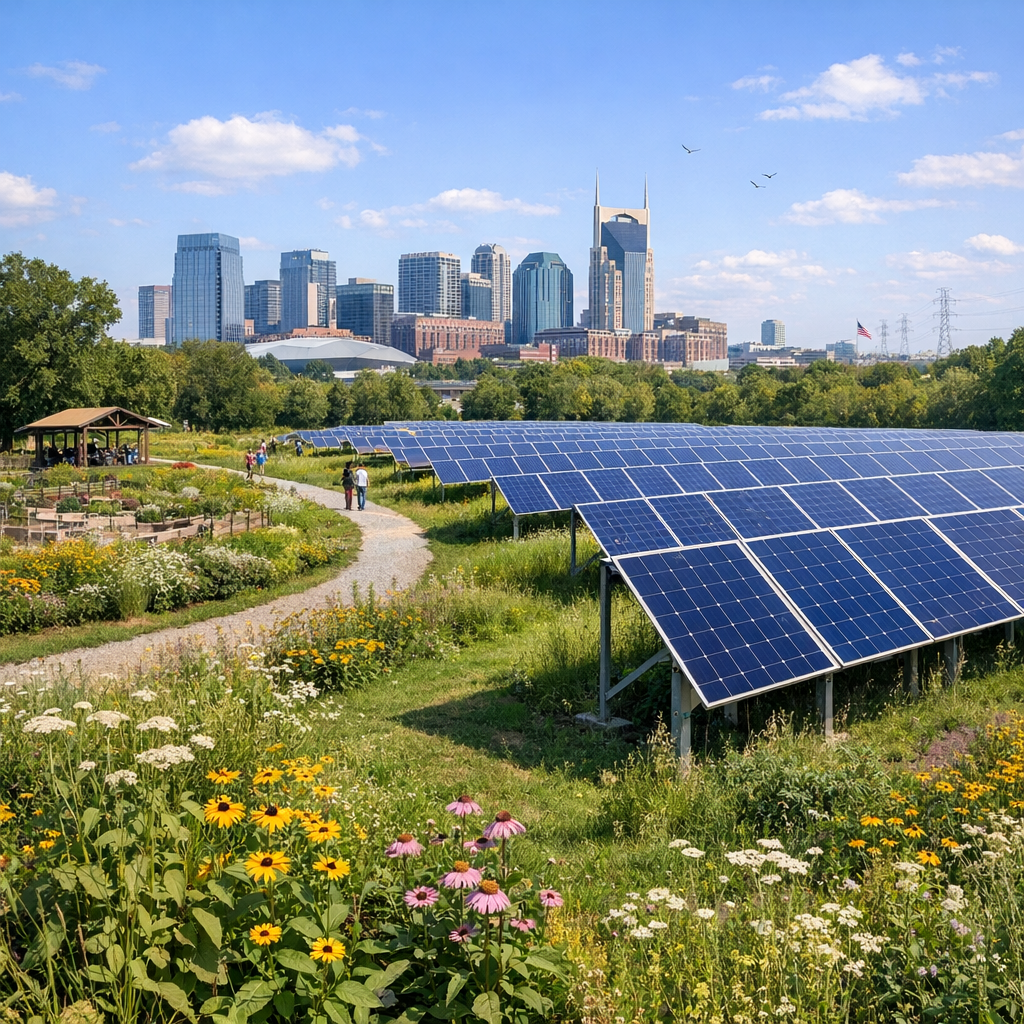
Nashville’s dedication to environmental sustainability is evident through various initiatives and community involvement. The city’s natural environment, encompassing air, water bodies, plants, animals, forests, and green spaces, provides essential services that support daily life. Preserving these assets ensures responsible use of finite resources and maintains the city’s unique character.
Community Solar Projects
In 2018, Nashville transformed a former landfill near Briley Parkway and I-65 into Music City Solar, the city’s first community solar project. This initiative has generated over 2 million kilowatt-hours of clean energy since its launch. Mayor Freddie O’Connell has proposed extending the lease for this successful project, highlighting Nashville’s commitment to renewable energy and repurposing unused land for environmental sustainability.
Expanding Green Spaces
Under Mayor O’Connell’s administration, the city acquired 300 acres of forest land to expand Beaman Park, marking one of the most significant conservation efforts in recent history. Located near Bull Run Road in northwest Davidson County, this expansion integrates into one of Metro’s most pristine natural preserves, emphasizing the essential role forests play in environmental health.
Urban Tree Canopy Enhancement
The Nashville Downtown Arboretum, launched in May 2025, features over 3,000 trees distributed along sidewalks, boulevards, and public areas in downtown Nashville. Managed collaboratively by the Nashville Downtown Partnership and the Nashville Department of Transportation, this initiative underscores ongoing efforts to expand and maintain the urban tree canopy.
Educational Initiatives
Organizations like Urban Green Lab teach communities how to live sustainably in Nashville and its surrounding counties. Their programs have reached nearly half of Davidson County’s zip codes, training educators and serving numerous organizations to promote sustainable living practices.
Climate Resilience Planning
Recognizing the impacts of climate change, Metro Nashville developed the Climate Adaptation and Resilience Plan (CARP) in September 2024. This plan aims to prepare the city and its residents to thrive amidst climate challenges by assessing the health of natural resources and developing concrete action plans based on expert analysis and community feedback.
Zero Waste Goals
In December 2019, Nashville’s Solid Waste Region Board approved a Solid Waste Master Plan to achieve 90% diversion of trash from landfills by reducing, reusing, recycling, and composting. This plan includes increasing recycling, food waste reduction, and composting throughout Davidson County, as well as adopting programs targeted towards the growing construction and demolition waste stream.
These initiatives reflect Nashville’s commitment to environmental stewardship and sustainability, ensuring a healthier and more resilient community for current and future generations.